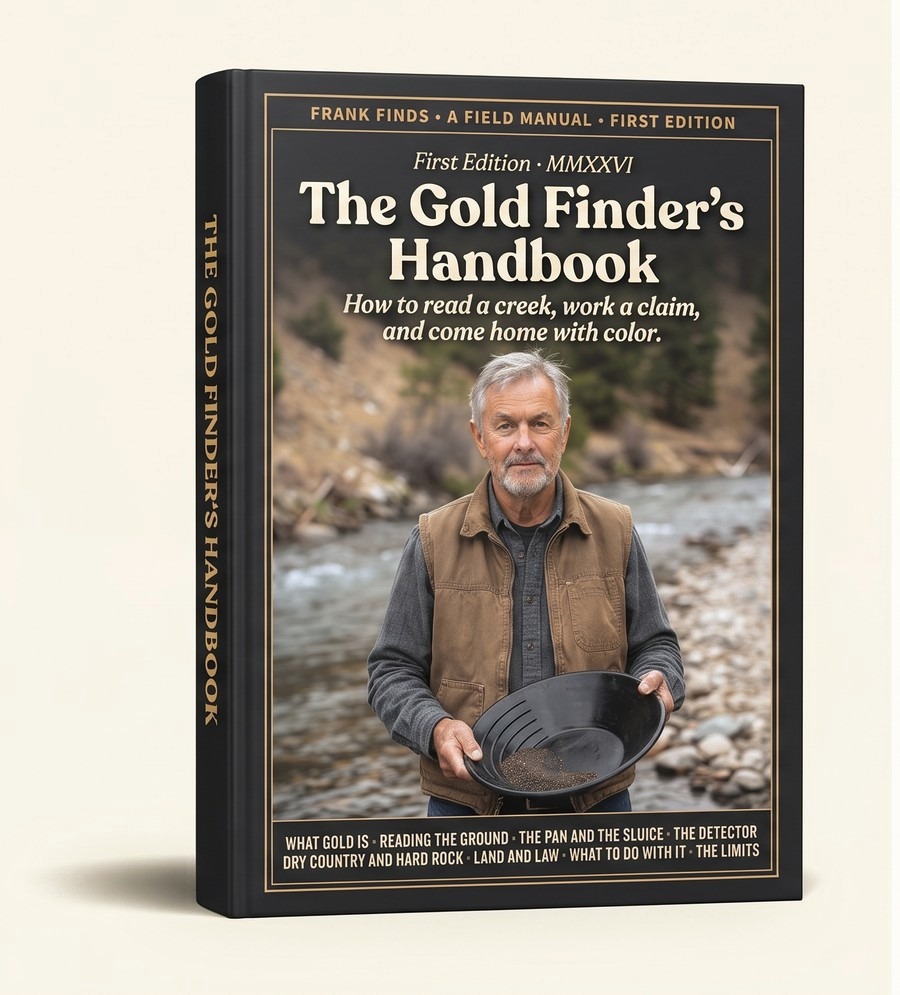
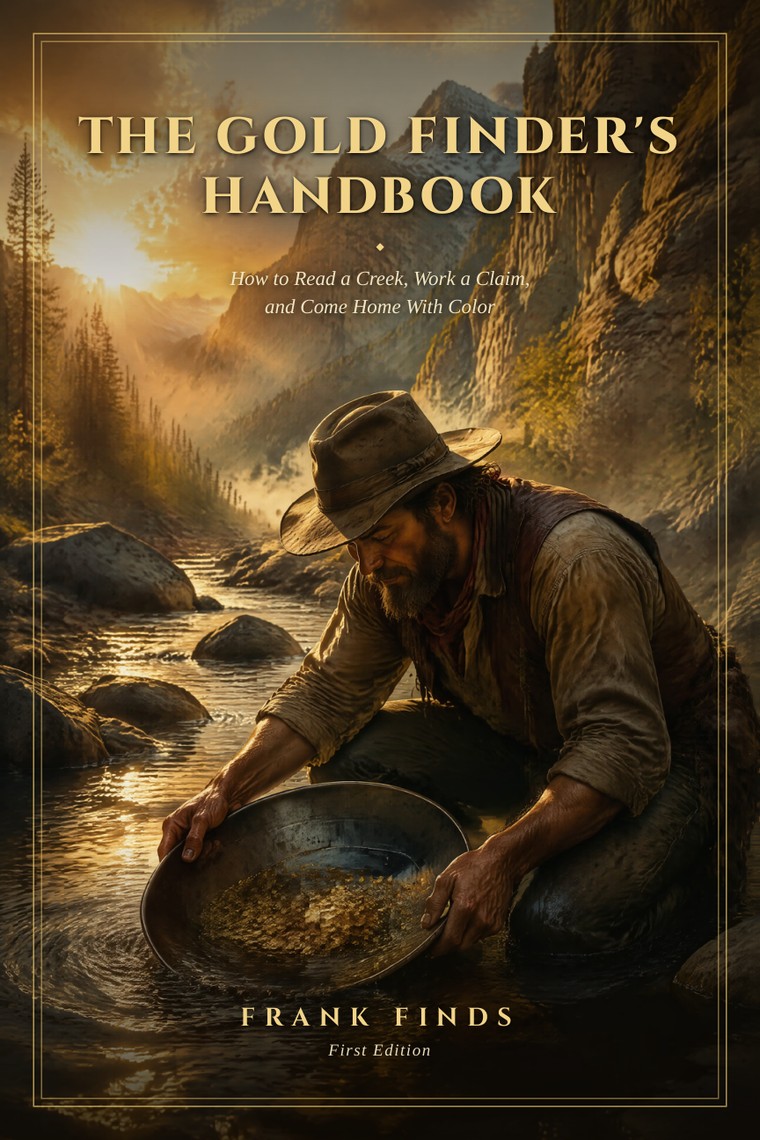
Ninety chapters on how to read a creek, work a claim, and come home with color — written for the man who has been out four weekends with a pan, found nothing, and is one bad Saturday from selling the kit.
"They dig in the wrong six feet of gravel, find nothing, and quit by the third weekend. The gold was thirty feet away and four feet down."
Before You Begin
This is a field manual, not a treasure story. There is a whole industry built on selling people the dream of gold and almost nobody selling them the skill of finding it. I would rather sell you the skill.
Here is the honest premise. There is still gold in the ground in this country, a great deal of it. The old timers were extraordinary at finding coarse gold with hand tools, and they were poor at recovering fine gold, poor at working ground with no water, and completely blind to anything they could not see with their eyes. Everything they missed is still there. Every flood since 1900 has moved more of it down out of the hills.
So that is what this book does. Ninety chapters in seven parts, organised the way a season is organised: what gold actually is and what to expect, then reading the ground, then the pan and the sluice, then the detector, then dry country and hard rock, then land and law, then what to do with the gold once you have it.
Every chapter opens with the situation as you will actually meet it in the field, walks through the method the way one man explains it to another standing in the water, and closes with a section called The Limits — what the method does not do, where it fails, what it costs, and when you need a permit, a professional, or a different plan entirely.
Get the Handbook — $47 $27The difference between a man who finds gold and a man who moves gravel is not luck, and it is almost never equipment. Here is what changes.
Every chapter ends with The Limits. Read them. It is the most valuable part of every chapter — most of the money wasted in this hobby is wasted by people who read the method and skipped the limits.
"Two seasons on the same creek with nothing to show. Read Part Two, moved sixty feet upstream to the head of the bar, went down to the clay. Eleven colors in the first pan."
"The classifying chapter alone. I had been throwing my fine gold out with the tailings for three years and never once suspected it."
"Part Six saved me from a very expensive mistake. I was one weekend away from working ground that turned out to be an active claim."

First in the creeks of northern California, because a man at a gas station told me where to park. Later across most of the western states with a pan, a sluice, a drywasher, and eventually a detector that cost more than my first truck.
I have had seasons where I found less than a gram. I have had days where I found more than a month of wages. I have learned the difference between those two outcomes, and the difference is almost never luck. It is where you chose to stand, how deep you were willing to go, and whether you sampled before you dug.
On the channel I take these one at a time. The handbook is all ninety of them in one place, in order, with the reasoning underneath — so you can apply it to a creek I have never seen and a district I have never worked.
And leave it better than you found it. Fill your holes, carry out the trash, respect claims, ask permission. Access to this country is being lost a little every year, and the largest single factor within our control is whether the people who manage the land think of prospectors as a problem.
It is a field manual. There are no lost mine legends in it, no maps to a secret canyon, and no promises about what you will find. It is how a creek sorts its load, where the gold sits in the gravel column, how to set a sluice so it stops losing what you feed it, and what the law says about the ground you are standing on. What you find depends on the ground and the work, and the book says so on the first page.
The videos are one idea at a time, in whatever order I filmed them that month. The handbook is all ninety in the order a season actually runs, with the reasoning underneath each one and The Limits at the end of every chapter. If you would rather fix your approach over a winter than over five years of weekends, that is what you are paying for.
Because the people I want reading this are the ones deciding whether to spend that money on gas to the creek. $27 is the launch price against $47. It is less than a classifier set and a fraction of the first drywasher you would have bought before you knew whether you needed one.
A single illustrated PDF, 149 pages, delivered by Gumroad the moment you pay. It opens on a phone in a canyon with no signal if you download it first, on a tablet, on a laptop, or you can print it and leave it in the truck. No app, no login to remember, no subscription.
No. Part One assumes you know nothing — what gold is, what an ounce actually looks like, the cheapest kit that works, and the gear that wastes your money before you have any idea whether you need it. Chapter 29 teaches panning from the beginning. Then it keeps going for another sixty chapters, so the book does not run out from under you in year two.
Not in coordinates, and be careful with anyone who sells you those. It teaches you to find your own ground: reading a topo before you drive, using old mining records to pick a district, finding open ground in federal records, and then reading the water once you are standing in it. That skill works on a creek nobody has told you about, which is the only kind worth having.
It depends entirely on the parcel, and it changes. Part Six is twelve chapters on exactly this — who owns the ground, what is open to mineral entry, what a claim marker looks like in the field, which state rules trip up travelers, and how to ask a landowner and get a yes. Confirm the rules for the specific ground you intend to work before you put a shovel in it. Nothing in the book is legal advice.

Ninety chapters on reading the ground, working the water, and staying legal on the claim — $27 during launch instead of $47. The gold is thirty feet away and four feet down. This is the book that tells you which thirty feet.
Get the Handbook — $47 $27